
Two Events this week

Hi all,
Two very interesting events this week — “Philosophies of the South: Decolonizing Knowledge” on Monday and “The Philosopher and the News: The Philosophy Behind Palantir” on Tuesday. Also enjoy a Sunday Read from the archives.
______________________________
Sunday Read
“Psychedelics and the Limits of Naturalism”: A Review by Peter Sjöstedt-Hughes
In this review, Peter Sjöstedt-Hughes questions whether naturalism can adequately explain experiences of unity, transcendence, and meaning revealed through psychedelic states. Through debates on consciousness, predictive processing, and metaphysical insight, Sjöstedt-Hughes argues that psychedelic states expose unresolved philosophical problems surrounding mind and reality. He ultimately suggests that psychedelics may expand philosophical inquiry itself.
Read here!
______________________________
Monday Event: May 11 11am PT/2pm ET/7pm GMT
“Philosophies of the South: Decolonizing Knowledge”: Radha D’Souza in conversation with Rinaldo Walcott
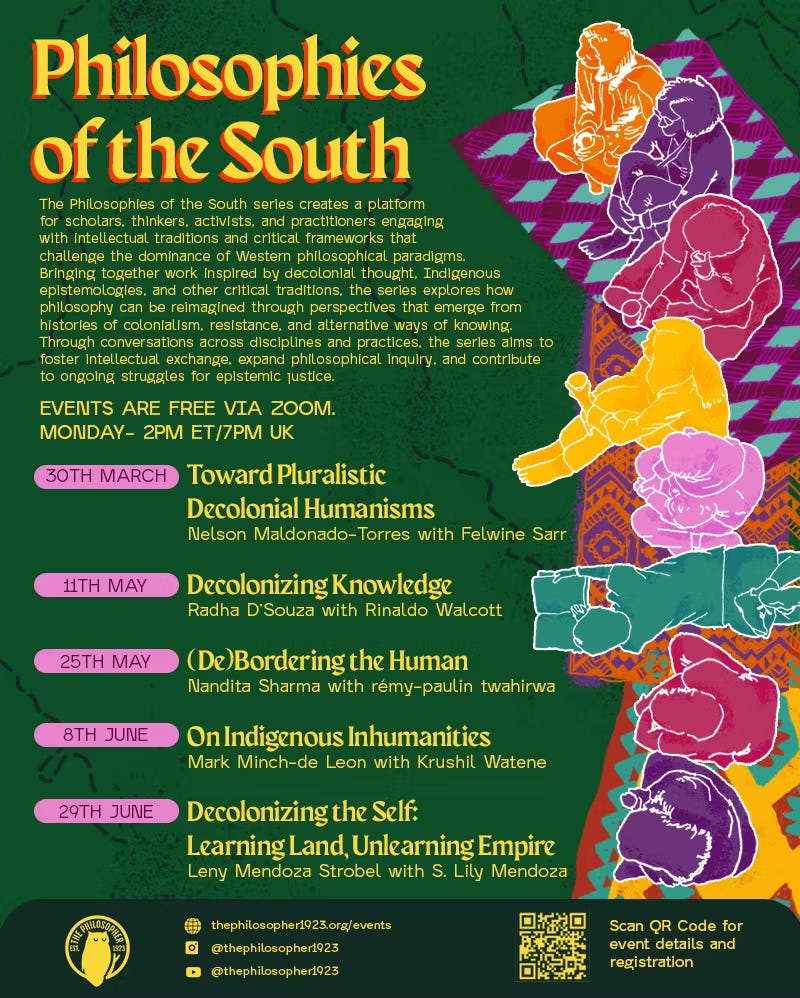
What does it mean to decolonise knowledge today? In this conversation, Radha D’Souza and Rinaldo Walcott reflect on the intellectual and political stakes of challenging dominant forms of knowledge produced through colonial and imperial histories. Drawing on anti-colonial thought, Black studies, and critical legal scholarship, they explore how knowledge emerges from struggles for freedom and how these traditions continue to shape debates about justice, power, and liberation today.
Radha D’Souza is Professor of Law, Development and Conflict Studies at the University of Westminster. She is a lawyer, social justice activist, writer and commentator. Her inter and transdisciplinary research straddles Legal Studies, Development Studies, History, Comparative Philosophy, Resource Conflicts and Geography, from Third World perspectives. Together with Dutch artist Jonas Staal, she is co-founder of the art project Court for Intergenerational Climate Crimes.
Rinaldo Walcott is Professor and Chair of Africana and American Studies at the University at Buffalo. His teaching and research are in the area of Black diaspora cultural studies and postcolonial studies with an emphasis on questions of sexuality and gender. He is the author most recently of On Property (Biblioasis, 2021) and The Long Emancipation: Moving Toward Black Freedom (Duke University Press, 2021).
Register for the event here.
______________________________
Tuesday Event: May 12 11am PT/2pm ET/7pm GMT
“The Philosopher and the News: The Philosophy Behind Palantir”: Alexis Papazoglou in conversation with Moira Weigel and Anthony Burton

Last month the tech company Palantir published what was widely described as its manifesto. According to the company’s post on X it was meant as a brief version of the book The Technological Republic, co-authored by Alex Karp, co-founder and CEO of Palantir, and Nicholas W. Zamiska, head of corporate affairs and legal counsel at Palantir. The manifesto claims among other things that AI will replace nuclear weapons as the new deterrent, calls for the return of a universal national service and argues that Silicon Valley has a moral obligation to participate in the defence of the United States.
The bullet points of the manifesto don’t seem on the surface to be advancing a coherent philosophy, having been described as “the ramblings of a supervillain” by a British MP. ButAlex Karp has an usual background for a tech CEO, having completed a PhD in philosophy in 2002 at the J.W. Goether University in Frankfurt Germany, with a thesis entitled Aggression in the Life-World. So, does Karp’s training in the philosophy of the Frankfurt School find expression in Palantir’s manifesto? Is this a version of technofascism? And what can we do when powerful tech companies start thinking they have deep insights into geopolitics, public policy and the state of “Western civilization”?
Moira Weigel is Assistant Professor of Comparative Literature at Harvard University and Faculty Associate of the Berkman Klein Center for Internet and Society. She writes and teaches about the history, theory, and social life of media and communication technologies, from the early nineteenth century to the present. She is the author of the book, Labor of Love: the Invention of Dating (2016) and co-editor with Ben Tarnoff of Voices from the Valley: Tech Workers Talk About What They Do and How They Do It (2020). She is also author of the essay Palantir goes to the Frankfurt School. She regularly contributes to general interest publications including The New York Times, The Guardian, and The New Republic.
Anthony Burton is a postdoctoral researcher in the Media Studies department at the University of Amsterdam. He completed his Ph.D. in Communication at Simon Fraser University, where he was a Mellon-SFU Data Fluencies Fellow at the Digital Democracies Institute. His dissertation is about the relationship between social theory, intelligence, desire, and mimesis in contemporary late fascist politics. He is the co-author of the book Algorithmic Authenticity (2023).
Alexis Papazoglou is Managing Editor of the LSE British Politics and Policy blog. He was previously senior editor for the Institute of Arts and Ideas and a philosophy lecturer at Cambridge and Royal Holloway. He is also host of the podcast, “The Philosopher and the News”.
Register for the event here.
______________________________
Event Recordings:
You can always check out our YouTube channel to watch any webinars you miss.
Closing:
The Philosopher is unfunded and directly relies on your support to keep doing the work we do. The best way you can do this is becoming a supporter via Patreon, if you’re not already. This helps us to keep our events series free and to pay our contributors. Find out more and become a member.
Best,
Andie Cook, Substack Manager